Mal’akh
The Lost SymbolMal’akh is the identity Zachary Solomon constructs after escaping a Turkish prison under a false death, and the name he gives to a long campaign of revenge and self-transformation. He pursues a hidden Masonic secret as both a treasure and a means to spiritual apotheosis, using disguises and deception to draw Robert Langdon and Katherine Solomon into his plan and force Peter Solomon to help him. His story turns on a stark reversal: the son Peter believes dead returns as the captor demanding that his father recognize him, then fails to obtain the willing sacrifice on which his final ritual depends.
Identity and Self-Creation
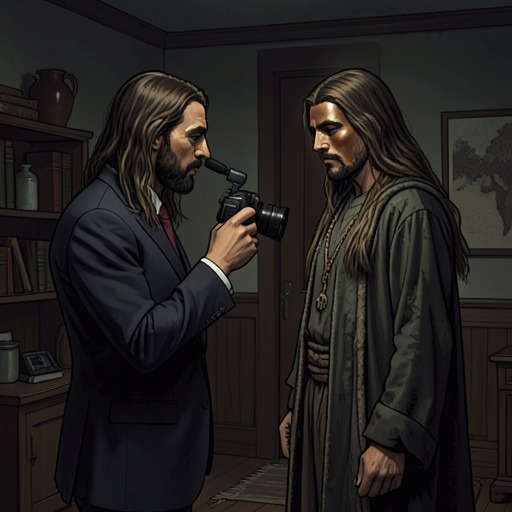
Mal’akh treats identity not as a stable inheritance but as something to be remade. Before adopting the name, he is Zachary Solomon, the son of Peter Solomon. After his escape from prison, he takes the intermediate name Andros Dareios and eventually becomes Mal’akh. The novel reveals these identities gradually: the imposing tattooed antagonist first appears to have made himself into a new being, while the history beneath that appearance ties his chosen persona to the son his father believes has died.
Tattooing is central to Mal’akh’s idea of transformation. At the beginning of his story, he tattoos his shaved head and understands the process as a deliberate change, not an attempt at beauty. He regards physical pain and the marking of the body as forms of sacrifice through which a person may emerge altered. He calls himself a masterpiece, treating his body as both the result of this work and the medium through which he intends to complete it.
His tattoos form a symbolic design rather than a collection of unrelated marks. A spiral staircase runs up his back, its steps placed along his vertebrae; a snake circles the small area of unmarked skin at the crown of his shaved head; and a double-headed phoenix covers his chest. That final patch of bare skin has a particular purpose: Mal’akh has reserved it for the act he believes will finish his transformation. The contrast between the carefully covered body and this waiting space makes his appearance a plan in progress, not simply a disguise or ornament.
Mal’akh also believes that transformation requires sacrifice. He fasts in preparation for the night’s work and regards discomfort as a temporary demand that will soon become unimportant. He has undergone castration, which he interprets as a spiritual sacrifice and a break with material life. His reasoning makes bodily change part of a larger ambition: he seeks to move beyond ordinary human limits and become a figure of divine power. The distinction between his conviction and the outcome of his actions remains important; the transformations he performs on himself do not grant him control over the people whose participation he needs.
From Prisoner to Mal’akh
The name Mal’akh conceals a history of loss and calculated substitution. In a Turkish prison, Zachary recognizes that money can buy release even though Peter will not pay for his freedom. As Inmate 37, he proposes a deal to the prison administrator: Zachary will be declared dead, the administrator will gain the money needed to leave, and both men can disappear. The plan depends on substituting another prisoner for Zachary. A sickly inmate is dressed in Zachary’s clothes and beaten beyond recognition; the false remains are photographed and placed in a sealed casket that Peter later buries, believing it contains his son.
The scheme works. Zachary leaves prison alive, while his family accepts the staged death as real. He then changes his appearance through experimental growth hormones and steroids, which drastically alter his physique and damage his vocal cords, leaving him with a permanent whisper. He becomes Andros, then Mal’akh. The new names and body allow him to conceal the person he was, but the scars from the night of the shooting remain beneath his tattoos. He interprets survival after Peter’s gunshot as a decisive passage through destruction, and as proof that his adopted identity was his destiny.
His later account of that history recasts personal grievances as the origins of a sacred mission. He recalls encountering the figure of Moloch in John Milton’s Paradise Lost and deciding that the name translated into the ancient tongue as Mal’akh could become his own. He describes the transformation as requiring a true sacrifice, not the lesser offerings he had previously made. This language gives his revenge a ceremonial frame: the injury and abandonment he attributes to his father become, in his telling, the necessary beginning of an ascent.
Disguise and the Search for the Secret
Mal’akh’s methods rely on making observers accept the identity most readily suggested by what they see. In Washington, he enters the Capitol dressed as an injured visitor, with a sling, a limp, a surplus coat, and makeup covering his tattoos. Padding alters his outline, while the sling conceals an object he is carrying into the building. Once inside, he changes clothes in an alcove and leaves by an eastern exit, abandoning the apparent injury and moving with a different bearing. The escape demonstrates the practical value of the transformations he has rehearsed: a costume need only last until suspicion is directed elsewhere.
He later uses the alias Dr. Christopher Abaddon to approach Katherine. Impeccably dressed and presenting himself as a polished, unusually young professional, he claims to have been seeing Peter and says that Peter has confided in him. He tells Katherine that Peter has spoken about guilt and the night their mother died. The story gives him a pretext to win Katherine’s trust and probe for information that could help him reach the secret he seeks. When she later reports that Peter is on his way to her laboratory, Mal’akh conceals his excitement and continues the impersonation rather than revealing his purpose.
His disguises extend beyond the Abaddon persona. He uses a chauffeur’s cap and later a blond wig, adjusting his clothes and checking his makeup before entering a private residence. Investigators subsequently find that the wig contains a gel-pack battery and a concealed fiber-optic camera. The discovery makes the disguise more than a means of changing his apparent appearance: it is also equipment for observing others while keeping the observer hidden. His careful preparation reflects the same principle as his tattoos, turning the body and its presentation into instruments for a larger design.
The object of that design is a secret Mal’akh believes is hidden in Washington and connected to Masonic wisdom. Three weeks before the opening events, he ascends to the thirty-third degree, the highest echelon of the brotherhood described in the novel. He treats this initiation as access to a world whose members guard their knowledge through symbols, legends, and allegory. Yet he remains impatient with concealment: initiation is not enough, and he seeks the hidden location itself. He pursues the pyramid’s clues toward Heredom, another name for the House of the Temple, believing the Lost Word is hidden beneath it.
Mal’akh’s plan also depends on other people solving what he cannot. He has chosen Langdon, an outsider to the Masons, to guard the pyramid, and he interprets that choice as useful precisely because Langdon is not part of an inner circle. After Langdon and Katherine decipher the pyramid, Mal’akh rejects their attempt to keep information from him and accuses them of withholding what he needs. His pursuit thus combines knowledge with coercion: he wants the secret decoded, but he also wants to dictate who may interpret it and what they must surrender in exchange.
Peter, Katherine, and the Return of Zachary
Peter is the center of Mal’akh’s grievance and the person whose recognition he ultimately wants. Mal’akh blames his father for the choice between wealth and wisdom offered to Zachary, for pressing him to join the Masons, and for leaving him in prison rather than bringing him home. He presents these decisions as proof that Peter failed him. The demands are also bound to a deeper injury: Peter does not recognize the adult Mal’akh as his son. In the Temple chamber, Mal’akh finally discloses his identity and explains that the prison photographs and buried casket belonged to the substituted prisoner, not to Zachary.
The revelation changes the meaning of the conflict. Peter has spent years believing his son is dead; Mal’akh has spent those years remaking himself while carrying his anger toward his father. The recognition is not a reconciliation. Mal’akh uses the truth to intensify Peter’s distress and make the past serve his present demands. Even after Peter understands who stands before him, Mal’akh continues to treat him as the person who must supply the final ingredient for his transformation.
Katherine becomes a target because Mal’akh suspects she may hold information about the family secret. His Abaddon impersonation allows him to question her under the appearance of helping Peter. Later, he uses her safety as leverage against Peter, threatening to expose a Masonic ritual video and insisting that Peter can save both his sister and the brotherhood by telling him what he wants to know. His manipulation repeatedly converts family bonds into pressure points: Peter’s concern for Katherine is made part of the threat, just as Peter’s history with Zachary becomes the grievance used to justify the ritual.
Langdon is another necessary participant, though Mal’akh’s connection to him is strategic rather than familial. He has arranged for Langdon to become involved with the pyramid and expects him to find its meaning. At the mansion, Mal’akh lures Langdon and Katherine into a trap by using a security guard to deliver a false message that Peter is safe. Once they arrive, the guard is killed, Langdon is rendered unconscious, and Katherine is restrained. Mal’akh then uses Langdon’s peril to force Katherine to comply, turning the search for knowledge into an immediate struggle over survival.
Ritual, Failure, and Narrative Role
Mal’akh’s pursuit culminates in the Temple chamber, where he prepares a ritual using Peter’s blood. He has waited for the moment and treats the final ingredient as the completion of a process begun through years of self-transformation. The reserved patch of skin on his head, the feather used to apply the blood, the altar, and the incense make the ceremony the endpoint toward which his bodily symbols and spiritual ideas have been directed. For Mal’akh, this is not merely an attempt to locate the Lost Word; he expects the ritual to release his soul and fulfill his claim to a higher state.
His intended offering depends on Peter’s participation, but Peter refuses to spill Mal’akh’s blood. The Akedah knife is broken against the granite altar, and a helicopter’s arrival shatters the chamber’s skylight and disrupts the ritual. The scene overturns Mal’akh’s assumption that the father he has reduced to a captive will complete the act he demands. Peter’s refusal does not erase the harm Mal’akh has done or repair their relationship; it denies Mal’akh the final consent his ceremony requires. The ritual fails at the point where his own theory of sacrifice most needs another person to act.
Mal’akh’s arc is therefore built from a sequence of transformations that never produce the mastery he expects. He survives a shooting, escapes prison through a substituted death, changes his body, adopts new names, enters a Masonic hierarchy, and disguises himself to move through Washington. Each change helps him conceal or advance his plans, but none can compel Peter’s recognition or make the final ritual succeed. His body becomes a readable map of ambition, while the blank space he reserves for completion remains a sign of what he cannot secure by force.
The character also drives the novel’s contrast between guarded knowledge and the uses to which a seeker may put it. Langdon describes Freemasonry as a society with secrets, distinguishing secrecy from the notion that the organization itself is hidden; Mal’akh, by contrast, treats guarded knowledge as a prize that entitles him to intrusion and coercion. His initiation gives him status, but he remains focused on extracting a secret from others. The difference between access and understanding, and between symbolic transformation and ethical change, shapes his conflict with Peter and the failure of his promised apotheosis.